MLZ is a cooperation between:
 > Technische Universität München
 > Helmholtz-Zentrum Hereon
 > Forschungszentrum Jülich
MLZ is a member of:
 > LENS
 > ERF-AISBL
MLZ on social media:




MLZ (eng)
Lichtenbergstr.1
85748 Garching
16.01.2026
Tireless for neutrons
From 3 December to 4, 2025, the neutron community gathered for the Heinz Maier-Leibnitz Zentrum (MLZ) User Meeting. Around 230 participants came together – once again in a year without neutrons from Garching, but with a palpable sense of solidarity and a focus on restarting the research neutron source.
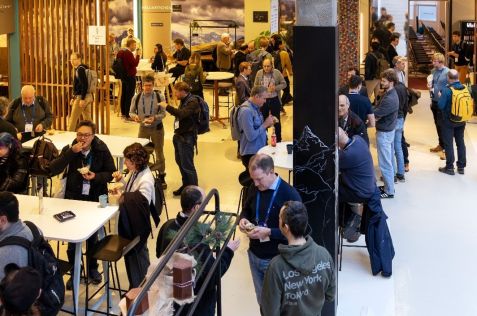
The MLZ User Meeting in Munich offered the international neutron science community an opportunity for productive exchange and networking. © Iris Köhler, Forschungszentrum Jülich/MLZ
“When it comes to science, I’m never tired,” quotes Prof. Dr. Tommy Nylander (Lund University), chair of the User Committee, physicist Erich Sackmann (1934–2024), a pioneer of neutron research in biophysics. The quote symbolised the mood at the User Meeting. “I am very optimistic that the FRM II will soon be back in operation, not least thanks to the good work of the management, which has mastered technical and bureaucratic challenges,” said the representative of the User Committee.
Progress during the break
To kick things off, MLZ directors Prof. Christian Pfleiderer from TUM and Prof. Martin Müller from Helmholtz Zentrum Hereon provided an update on the current status of FRM II and shared news from MLZ. The focus was on the construction of the central channel. After intensive development work, the final test for the start of production is now pending, as Christian Pfleiderer reported.
The engineers, technicians, and researchers at FRM II and MLZ utilized the involuntary break in operations to undertake extensive infrastructure upgrades. For example, the East Neutron Guide Hall was completed, in which state-of-the-art scientific instruments were installed. The researchers used complementary measurement methods at FRM II, supported measurement campaigns at international neutron sources, and provided their expertise to visiting measurement teams. In addition, they further developed the instruments technically and made important progress in converting to low-enriched nuclear fuel. Martin Müller supplemented the overview with an update on the strategic development programmes and networks in which the MLZ is active.
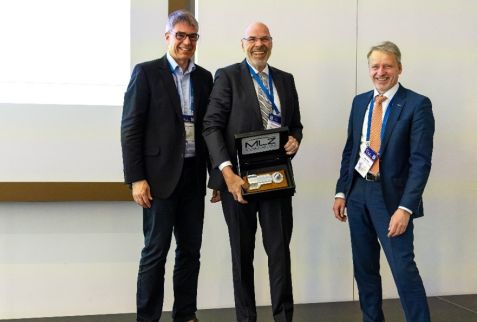
Prof. Dr. Stephan Paul (center) received the MLZ Prize from Prof. Dr. Martin Müller (right) and Prof. Dr. Christian Pfleiderer (left). © Iris Köhler, Forschungszentrum Jülich/MLZ
New MLZ Director from 2026
The 2025 User Meeting also marked Martin Müller’s last official appearance as MLZ Director, whose term of office ends after five years. As of 2026, Prof. Dr. Stephan Förster from the MLZ partner Forschungszentrum Jülich will assume the position. Stephan Förster already held this role from 2018 to 2020. Christian Pfleiderer expressed his gratitude to Martin Müller for his commitment.
A highlight of the first day of the conference was the presentation of this year’s MLZ Prize to Prof. Dr. Stephan Paul (TUM) for his pioneering work in researching questions of particle physics with neutrons.
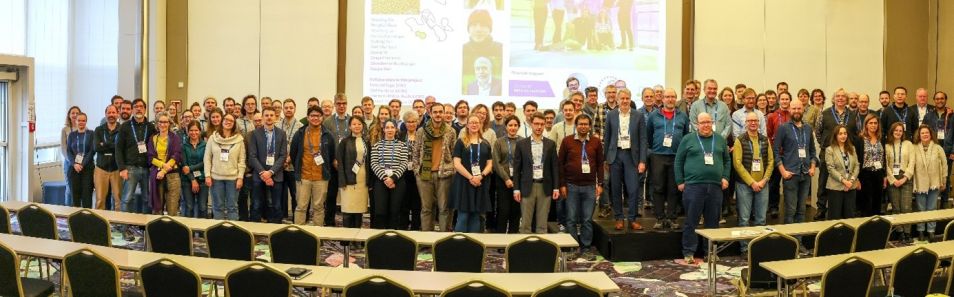
Around 230 scientists took part in the MLZ User Meeting 2025. © Iris Köhler, Forschungszentrum Jülich/MLZ
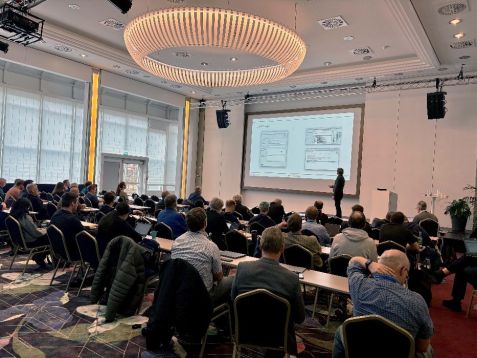
Christian Felder from MLZ presented the innovations in research data management. © Laura Richter, FRM II/TUM
The user perspective
Dr Michael Schulz, Deputy Scientific Director at FRM II and member of the elected committee, welcomed the participants on behalf of the Committee for Research with Neutrons (KFN) and KFN Chair Prof. Dr Mirijam Zobel. He pointed out that the next committee will be elected in spring 2026. According to Michael Schulz, the main objectives for the coming year will be to better consolidate user needs and raise awareness of neutron research among politicians and the general public.
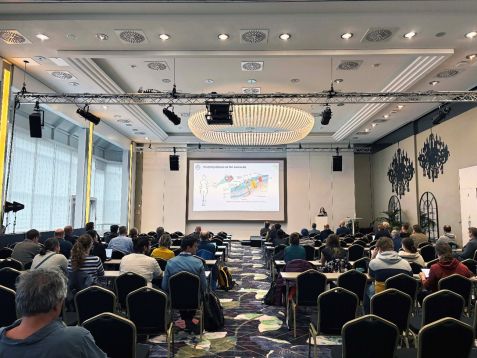
Dr. Hanna Barriga from KTH Stockholm, Sweden, gave her keynote speech on the structure and function of lipid nanoparticles in medicine, which are to be used in medical implants. © Laura Richter, FRM II/TUM
From quantum phenomena to medical implants
In parallel sessions, researchers presented their latest findings on a wide range of topics – from materials science, polymers and proteins to particle physics and quantum phenomena.
The two keynote speeches were particular highlights of the user meeting: Dr Hanna Barriga from KTH Stockholm, Sweden, explained the structure and functions of lipid nanoparticles in medicine, for example, for applications in medical implants. In the second keynote speech, Dr Jasper Landman from Wageningen University in the Netherlands presented the latest findings on the stabilisation of protein structures in food research, with applications such as vegan cappuccino foam.
Focus on the restart
On the second day, MLZ researchers reported on their preparations for the restart in areas such as the sample environment, data management, and scientific instruments. The meeting was concluded with a poster session featuring 93 posters, providing an opportunity for discussion and personal conversations.
Moving forward together
The MLZ User Meeting 2025 showcased a community united in looking ahead, despite the ongoing shutdown. Or as Christian Pfleiderer put it: “We are doing everything we can to get the FRM II restarted as quickly as possible and to make neutrons available again to our 1,200 guest scientists for their research.”
Related News
-
-
 13.12.2024
“Fantastic breath in science”
-
 11.12.2023
User meeting despite ice and snow
Photo gallery


MLZ is a cooperation between:
> Technische Universität München> Helmholtz-Zentrum Hereon
> Forschungszentrum Jülich
MLZ is a member of:
> LENS> ERF-AISBL
MLZ on social media: