MLZ is a cooperation between:
 > Technische Universität München
 > Helmholtz-Zentrum Hereon
 > Forschungszentrum Jülich
MLZ is a member of:
 > LENS
 > ERF-AISBL
MLZ on social media:




MLZ (eng)
Lichtenbergstr.1
85748 Garching
08.06.2026
How battery electrolytes behave when heated
Lea Westphal of the Technical University of Munich (TUM) is the lead author of a new study that provides the most detailed, temperature-dependent picture of ethylene carbonate (EC) to date. EC is a solvent used in the electrolytes of lithium-ion batteries.
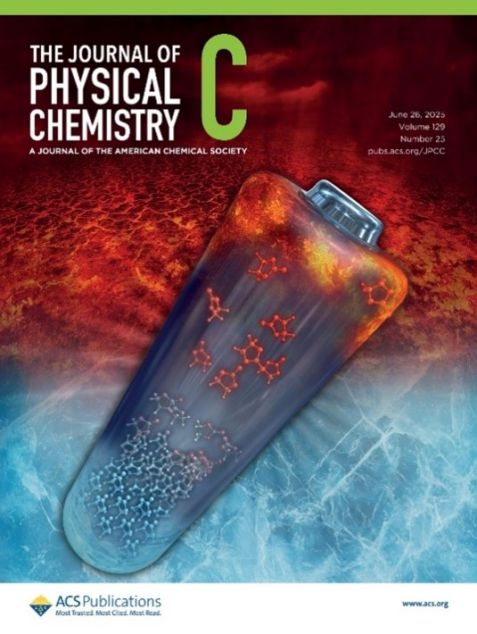
The illustration of the battery made it onto the cover of the journal in which the study was published. © Reiner Müller, FRM II / TUM, Lea Westphal et al. Published by American Chemical Society.
EC is found in almost all lithium-ion batteries, such as those in smartphones or electric cars. The substance helps form a protective layer on graphite anodes. “Thanks to this layer, the battery lasts longer because the electrodes and electrolyte are protected from degradation,” explains Lea Westphal, a doctoral student at the Heinz Maier-Leibnitz Zentrum.
Better predictions for industry
Even though EC is solid at room temperature and must be mixed with solvents that have a lower melting point to remain liquid, a precise understanding of how the molecules behave as temperatures change provides scientists and battery manufacturers with significantly better guidance. The team investigated how EC molecules arrange themselves and move from temperatures near absolute zero up to their melting point.
To track tiny changes in the EC crystal during heating, Lea Westphal’s team used neutron powder diffraction at two neutron sources: the SPODI instrument at TUM’s FRM II in Garching and the ECHIDNA instrument at ANSTO in Sydney. The measurements showed that EC maintains the same ordered crystal structure consisting of a fixed repeating unit from near absolute zero (-270°C) up to 36°C.
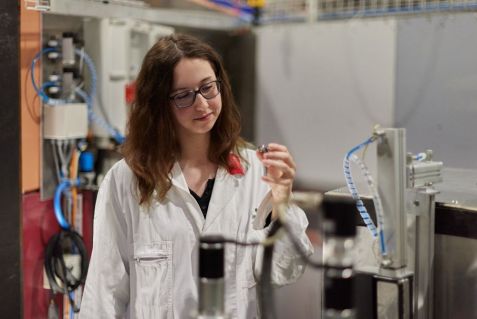
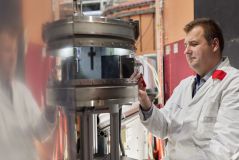
Lea Westphal with a sample container at the SPODI instrument at the Heinz Maier-Leibnitz Zentrum. © Bernhard Ludewig, FRM II / TUM
Expansion with rising temperature
The researchers also observed that the repeating unit expands noticeably as the temperature rises, as the molecules vibrate more strongly.
To understand the structural changes that occur during melting, the researchers analyzed the samples using high-energy X-ray powder diffraction at DESY (PETRA III) in Hamburg. They discovered that when EC melts, the regular arrangement of the molecules is lost, but each individual molecule retains its shape. “This means that the molecules survive the transition to the liquid state and merely lose their long-range alignment,” says Lea Westphal.
Useful for longer-lasting electrolytes
Lea Westphal explains why the study’s findings are important: “In practice, these improved predictions can accelerate the development of safer, longer-lasting electrolytes and help us select solvent mixtures or additives that perform reliably over a wider temperature range.”
Original publication:
L. Westphal, V. Kochetov, V. Baran, T. Hölderle, M. Avdeev, V. Diadkin, K. Marshall, A. Schökel, K. Opri, R. Niewa, F. Porcher, P. Müller-Buschbaum, A. Senyshyn (2025)
Temperature-Resolved Crystal Structure of Ethylene Carbonate.
The Journal of Physical Chemistry C. DOI: https://doi.org/10.1021/acs.jpcc.4c08421
Further information
The researchers used high-resolution neutron powder diffraction at SPODI at the FRM II research neutron source in Garching, as well as at the ECHIDNA diffractometer at the OPAL reactor, which is operated by ANSTO in Sydney. Synchrotron X-ray powder diffraction and high-energy total scattering (pair distribution function, PDF) measurements were performed at beamline P02.1 at PETRA III (DESY) in Hamburg, and supplementary PDF data were recorded at BM31 (SNBL) at the ESRF in Grenoble. Thermal analysis by differential scanning calorimetry (DSC) was performed by the authors using a NETZSCH DSC 204 F1 Phoenix instrument, and the molecular dynamics simulations were carried out using computing resources at the Leibniz Supercomputing Zentrum (LRZ) in Garching.
Related News
-
-
-
 29.09.2025
Towards More Efficient Batteries
MLZ is a cooperation between:
> Technische Universität München> Helmholtz-Zentrum Hereon
> Forschungszentrum Jülich
MLZ is a member of:
> LENS> ERF-AISBL
MLZ on social media: