MLZ is a cooperation between:
 > Technische Universität München
 > Helmholtz-Zentrum Hereon
 > Forschungszentrum Jülich
MLZ is a member of:
 > LENS
 > ERF-AISBL
MLZ on social media:




MLZ (eng)
Lichtenbergstr.1
85748 Garching
26.08.2026
Chocolate ice cream and superconductors
How many neutrons can fit on a football pitch? And how can a train float upside down? During their visit to the FRM II, the children from the Nachbarschaftshilfe Garching had loads of questions – and at the end, they even got a portion of homemade chocolate ice cream.

In the Neutron Guide Hall West, children from the Nachbarschaftshilfe Garching learn how neutrons are used in the research reactor. © Esther Schmid, FRM II / TUM
“Who knows what neutrons are?” asks press officer Anke Görg the ten children from the Nachbarschaftshilfe Garching, who are visiting the research reactor as part of their holiday programme. Mathilde puts her hand up. “They’re atoms.” Almost right, because neutrons are found inside atoms – or to be more precise, in the atomic nucleus, as the press officer explains. “If you imagine the atom to be as big as a football stadium, then a neutron would be about the size of a single grain of sand on the pitch.”
This marks the start of an introduction to the world of neutrons and how they are used at FRM II for scientific experiments. Again and again, the children’s hands shoot up as they bombard the scientists with questions. “How many neutrons would fit on a football pitch?” asks one of the boys. Dr Tobias Neuwirth pauses for a moment to consider the question. The answer depends somewhat on how you interpret the question. “One thing is clear, though: it would be a number larger than you can imagine.”

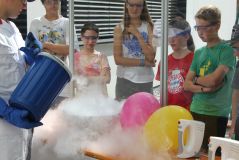
Dr Tobias Neuwirth demonstrates the difference between water and liquid nitrogen: water does not flow through a felt hat, whereas liquid nitrogen at -200 °C does. © Laura Richter, FRM II / TUM
Who controls the reactor?
Just like real scientists, the young visitors put on their lab coats before entering the reactor building. Once inside, the next question arises: “Who actually controls all that equipment?”, Julian asks.
To find out, they head down to the control room to meet the reactor operators. “We monitor everything here around the clock, control the reactor and carry out checks all the time,” says shift supervisor Georg Kaltenegger.
A levitating train
At the next station, the children have to put on safety goggles and wait behind a plexiglass screen. Scientist Dr Tobias Neuwirth is wearing thick protective gloves. And whatever he’s tipping out of the blue bucket into a bowl is steaming vigorously. The experiments that follow, using liquid nitrogen cooled to -200 °C, are the children’s highlight. The magnetic levitation train is particularly exciting.

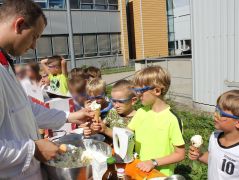
Using liquid nitrogen, cocoa, cream and sugar can be turned into delicious chocolate ice cream in just a few minutes. © Laura Richter, FRM II / TUM
“When superconducting material is cooled to extremely low temperatures, it hovers above the magnets and is more or less anchored in that position,” explains Tobias Neuwirth. The crazy thing about it? The whole thing even works upside down, without the superconductor falling to the floor. And so the train suddenly hovers beneath its magnetic tracks.
To round things off, there’s a tasty treat to cool down. Using liquid nitrogen, cocoa, cream and sugar are transformed into a delicious chocolate ice cream. “Really cool,” is the children’s verdict.


MLZ is a cooperation between:
> Technische Universität München> Helmholtz-Zentrum Hereon
> Forschungszentrum Jülich
MLZ is a member of:
> LENS> ERF-AISBL
MLZ on social media: