MLZ is a cooperation between:
 > Technische Universität München
 > Helmholtz-Zentrum Hereon
 > Forschungszentrum Jülich
MLZ is a member of:
 > LENS
 > ERF-AISBL
MLZ on social media:




MLZ (eng)
Lichtenbergstr.1
85748 Garching
09.12.2025
Cataracts: How proteins shape our vision
To better understand the dynamics and phase behaviour of protein mixtures under cell-like conditions, a research group from Lund investigated the crystalline proteins of the eye lens at the MLZ. Using neutrons, they showed that macroscopic properties can be predicted surprisingly well using simple mixing rules. The results provide new insights into age-related changes in the lens and open up perspectives for research into diseases such as Alzheimer’s or cataracts.

The eye lens proteins a-crystalline and yB-crystalline as a binary model system. © Canva
Our cells are bustling with activity: proteins and other biomolecules are crowded together in a very small space, an effect known as “macromolecular crowding”. This affects the stability, viscosity and reactivity of proteins. These effects are not only exciting from a biophysical perspective, but also have direct medical relevance: diseases involving defective protein deposits, such as Alzheimer’s, and lens disorders, such as cataracts and presbyopia, are closely related to this phenomenon.
Eye lens proteins as a model for binary protein systems
Physical models for solutions containing only one protein have already been well researched and are reliable. However, natural fluids such as cell plasma or blood serum consist of complex systems whose dynamics and flow properties are still poorly understood. The researchers have chosen the crystalline proteins of the eye lens as an illustrative model system: α-crystallin behaves like a large, almost inelastic sphere, while γB-crystallin tends to form temporary clusters at low temperatures.
“The system is simple because it has only two components: relatively spherical proteins – hard spheres without subdomains and internal dynamics. This allows us to approach more complex systems step by step,” sums up Dr. Olaf Holderer from Forschungszentrum Jülich, an instrument scientist at J-NSE.
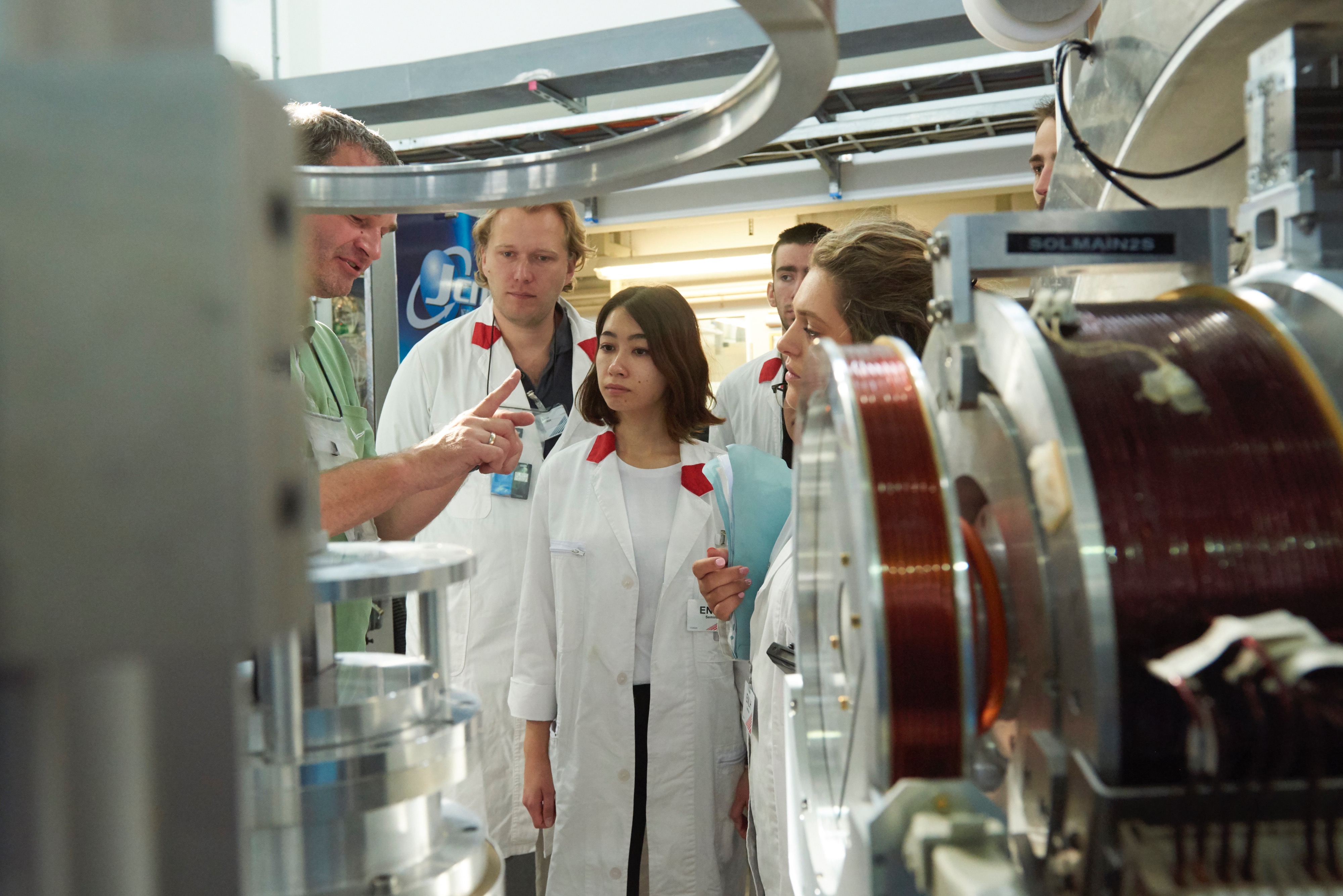
Dr.Olaf Holderer, who is responsible for the instrument, explains the J-NSE instrument. © Wenzel Schürmann / TUM
Simple rules, major impact
The results show that phase behaviour and viscosity at high protein concentrations can be described surprisingly well using simple mixing rules. This works like a kind of average value for the properties of the individual proteins. Deviations only occur in very small quantities or directly at the phase boundary. The interaction of larger groups of proteins also follows these simple mixing rules.
Microscopically oversimplified
On a microscopic scale, neutron spin echo spectroscopy performed at the J-NSE at the MLZ shows that short-lived clusters and directed surface interactions influence the collective motion of proteins.
The general trends are recognised by the mixing rules, but they overestimate the propagation on small length scales. At the microscopic level, the specific protein-protein interactions therefore require more detailed models.

In 2017, the instrument was upgraded to the J-NSE ‘PHOENIX’. The instrument is now equipped with superconducting main coils, which enable it to generate a magnetic field approximately three times stronger than the copper coils used previously. © Tobias Hase
Outlook for the lens
According to the study, small modifications to the protein connections can have a significant impact on the flexibility and transparency of the eye lens. This provides starting points for new therapeutic strategies for lens diseases.
“The next step is to test the approach with more complex mixtures and to use computer simulations to investigate length scales where our simple approach is no longer sufficient,” says Prof. Anna Stradner, who heads the research group in Lund, Sweden.
Models that take into account directed protein interactions are planned, as well as dynamic simulations of several crystalline proteins to clarify the relationship between the resilience of the lens and movement on the smallest scale.
Original publication:
Alessandro Gulotta, Saskia Bucciarelli, Felix Roosen-Runge, Olaf Holderer, Peter Schurtenberger, Anna Stradner. Testing mixing rules for structural and dynamical quantities in multi-component crowded protein solutions. APL Bioengineering 8, 026116 (2024)
DOI: https://doi.org/10.1063/5.0204201
Further information
Scientists from the Division of Physical Chemistry and the LINXS Institute of Advanced Neutron and X-ray Science at Lund University in Sweden and the Jülich Centre for Neutron Science at the MLZ were involved in the study.
Contact:
Dr. Olaf Holderer
Instrument Scientist J-NSE “PHOENIX”
Forschungszentrum Jülich GmbH
Tel.: +49 (0)89 158860-707
E-Mail: o.holderer@fz-juelich.de
MLZ is a cooperation between:
> Technische Universität München> Helmholtz-Zentrum Hereon
> Forschungszentrum Jülich
MLZ is a member of:
> LENS> ERF-AISBL
MLZ on social media: