MLZ is a cooperation between:
 > Technische Universität München
 > Helmholtz-Zentrum Hereon
 > Forschungszentrum Jülich
MLZ is a member of:
 > LENS
 > ERF-AISBL
MLZ on social media:



MLZ (eng)
Lichtenbergstr.1
85748 Garching
12.08.2026
MLZ Conference: How neutrons help fight cancer
From 6 to 9 July 2026, 48 researchers and industry experts gathered at Schloss Fürstenried in Munich for the MLZ conference ‘Neutrons for Future Health’. The conference featured presentations on bio-inspired materials for medical and industrial applications, as well as cancer therapies and drug development.

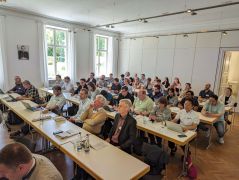
The poster session gave participants the opportunity to discuss their current research projects and new approaches directly with one another. © Iris Köhler, Forschungszentrum Jülich
After two days packed with fascinating presentations, the focus on Wednesday are ‘Neutrons against Cancer’. The keynote speeches focus on the production and use of medical radioisotopes, and the application of neutron beams in cancer treatment.
An infusion against cancer?
To begin with, co-founder Dr Richard Henkelmann explains how his company, ITM Isotope Technologies Munich SE, produces lutetium-177: thermal neutrons activate ytterbium-176 (Yb-177) to form Yb-177, which then decays into lutetium-177.
Dr Celine Wilke, Chief Medical Officer at ITM, expands on how these radioisotopes are used in cancer treatment. Lutetium-177 is coupled to a ligand, enabling it to bind to specific surface proteins on cancer cells. The radioactivity is released directly at the cell. “Patients receive various doses via a single infusion – a remarkably simple yet effective method,” explains Wilke.
Boron captures neutrons
An insight into how neutrons can be used directly to treat cancer was then provided by Prof. Dr. Wolfgang Sauerwein from the German Society for Boron Neutron Capture Therapy.

Dr Mara Egenhöfer in her talk on thermosensitive liposomes as a platform for the targeted delivery of irinotecan, an anti-cancer drug used to treat solid tumours. © Iris Köhler, Forschungszentrum Jülich
The use of thermal neutrons in boron neutron capture therapy (BNCT) is currently particularly promising. Sauerwein describes the procedure: “In this process, the boron previously introduced into the tumour tissue captures neutrons and releases energy that is confined to the size of a single cell.” In this way, boron-enriched tumour cells are targeted for irradiation whilst healthy cells are spared as much as possible. This method could now also be integrated into hospitals, given the availability of advanced accelerator technologies.
Neutron therapy in hospitals
Finland is a pioneer in this field, having completed the first European Phase I trial in April 2026. In her keynote speech, Dr Hanna Koivunoro of Neutron Therapeutics Finland Oy will present the initial results of the trial. Boron accumulates in significantly higher concentrations in tumours than in healthy tissue, to which up to 73 per cent of patients responded in the trial. “One notable feature is that this method can also be used to treat head and neck tumours, which are difficult to operate on due to their location – for example, directly behind the eyes,” explains Dr Koivunoro. The studies are now set to continue to make sure that BNCT is accepted as a standard treatment in hospitals.

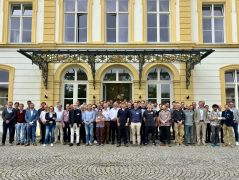
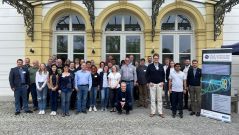
Group photo from the MLZ Conference 2026 in front of Schloss Fürstenried © Iris Köhler, Forschungszentrum Jülich
Prospects for health research
During the rest of the conference, participants continued to discuss a variety of topics related to neutron research and its applications in medicine. These included the characterisation of bio-inspired materials using neutrons and modern diagnostic methods. This was followed by fascinating insights into drug development and delivery. The poster session offered participants the opportunity to exchange views directly on current research projects and new approaches.
Finally, the presentations focused on investigations using scattering methods and the subsequent development of biologically realistic models of the cell envelope. Among other things, the importance of understanding bacterial surfaces for the development of new strategies to combat infections was discussed.
Dr Stefano Pasini, one of the conference organisers, summed up: “Health research is characterised by innovative approaches and international collaboration – neutrons make an important contribution to this and open up new possibilities for the medicine of the future.”
More information:
Programme for the MLZ Conference 2026
The BMFTR has declared 2026 the Year of Science for ‘Medicine of the Future’
Related News
MLZ is a cooperation between:
> Technische Universität München> Helmholtz-Zentrum Hereon
> Forschungszentrum Jülich
MLZ is a member of:
> LENS> ERF-AISBL
MLZ on social media: