MLZ is a cooperation between:
 > Technische Universität München
 > Helmholtz-Zentrum Hereon
 > Forschungszentrum Jülich
MLZ is a member of:
 > LENS
 > ERF-AISBL
MLZ on social media:




MLZ (eng)
Lichtenbergstr.1
85748 Garching
09.09.2026
How soil bacteria protect plants against diseases
Neutrons from the MLZ’s MARIA magnetic reflectometer for large incident angles have helped elucidate a mechanism by which plants activate their immune defences. These findings can be used to develop bio-based plant protection products.

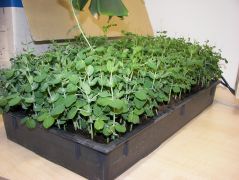
Soil bacteria can protect plants via the molecule surfactin, which interacts with the cell membrane and alters its structure. © Pixabay, PublicDomainImages
Plants are not defenceless against pathogens. Soil bacteria colonise their roots and send chemical signals to the plants. These signals prepare the plants to fight off diseases. An international research consortium led by the University of Liège in Belgium has now elucidated the molecular mechanism behind this immunization. The researchers show that the molecule surfactin, produced by bacteria of the genus Bacillus, does not act via an intermediate protein and a lock-and-key mechanism, but instead makes direct contact with the plant cell membrane. “Plants possess sophisticated defence mechanisms against diseases,” explains Dr Marc Ongena, Research Director of the Belgian Fund for Scientific Research at the University of Liège. “We already knew that certain root bacteria produce molecules that stimulate plant defence mechanisms. But until now, little was understood about how these molecules were recognised by plant cells.”
From root to leaf
The researchers focused on surfactin and its interaction with Arabidopsis thaliana, a model plant commonly used in plant biology. They were able to demonstrate that surfactin binds to a molecule found in the root cell membrane. “This interaction leads to a slight restructuring of the membrane, which increases its tension, in turn activating mechanosensitive ion channels,” explains Magali Deleu, a senior FRNS research fellow at the University of Liège. This triggers a signalling cascade that spreads from the roots to the leaves and prepares the plant to better resist pathogens. These include, for example, the fungus Botrytis cinerea, which causes grey mould and inflicts significant damage on crops such as grapevines, strawberries, tomatoes, and lettuce.

Dr Alexandros Koutsioumpas is an instrument scientist at the MARIA neutron reflectometer, where the measurements of the plant membrane were carried out. © Wenzel Schürmann, TUM
Altered membrane structure
Measurements taken with the MARIA neutron reflectometer, operated by the Jülich Centre for Neutron Science (JCNS) at the Heinz Maier-Leibnitz Zentrum (MLZ) in Garching, provided evidence of minute structural changes in the subnanometer range in plant membranes during their interaction with surfactin molecules. “Analysis of our data suggests both a thinning of the membrane by a few angstroms and a structural rearrangement of the upper membrane layer upon interaction with surfactin,” explains Dr. Alexandros Koutsioumpas of the Forschungszentrum Jülich, an instrument scientist at MARIA. “Data from other measurement methods complement and support the picture of a surfactin-induced restructuring and increased membrane tension, which may activate mechanosensitive channels.”
Bio-based plant protection
This defence mechanism differs from plants’ classical innate immunity, through which they typically recognise foreign molecules using the lock-and-key principle. In the newly discovered mechanism, the change in the membrane itself serves as the trigger signal. These findings shed new light on how plants perceive their microbial environment and distinguish between beneficial bacteria and true pathogens.
In practice, this research is part of efforts to develop a new generation of bio-based plant protection products, the researchers write in their paper published in Nature Plants. If we understand exactly how these bacteria or their molecules activate plant immunity, we can develop more targeted and effective plant protection strategies that can partially replace chemical agents. The results thus provide a foundation for the development of bio-based products in sustainable agriculture.
Original text: University of Liège, 7.5.2026, modified and supplemented by Forschungszentrum Jülich and FRM II / MLZ
Original publication:
G. Gilliard, J. Pršić, JM. Crowet et al., Membrane remodelling mediates lipopeptide-induced immunity in Arabidopsis, Nature Plants 12, 1034 (2026)
DOI: doi.org/10.1038/s41477-026-02270-3
Related News


MLZ is a cooperation between:
> Technische Universität München> Helmholtz-Zentrum Hereon
> Forschungszentrum Jülich
MLZ is a member of:
> LENS> ERF-AISBL
MLZ on social media: