MLZ is a cooperation between:
 > Technische Universität München
 > Helmholtz-Zentrum Hereon
 > Forschungszentrum Jülich
MLZ is a member of:
 > LENS
 > ERF-AISBL
MLZ on social media:



MLZ (eng)
Lichtenbergstr.1
85748 Garching
11.09.2026
How non-destructive testing methods are driving sustainable production
How can non-destructive testing methods help to use materials more efficiently, increase product longevity, and accelerate the circular economy? At the 10th TUM Expert Forum on 3 September 2026, experts from science and industry discussed non-destructive measurement techniques and their potential for industrial applications.

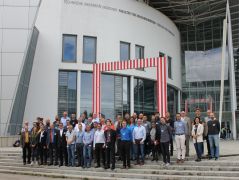
Participants and speakers at the 10th TUM Expert Forum 2026. © Laura Richter, FRM II/ TUM
Dr habil. Ralph Gilles, Industry Coordinator at the Research Neutron Source Heinz Maier-Leibnitz (FRM II), opened the tenth edition of the TUM Expert Forum, with over 60 registered participants from industry and academia. The joint event, organised by TUM and the VDI Technical Committee 101 “Non-Destructive Testing”, focused on the question of how non-destructive testing (NDT) methods can make material production more sustainable.
Kicking off the event, the Scientific Director of the FRM II, Prof. Dr Christian Pfleiderer, emphasised the value of neutrons, which, as a unique probe, penetrate deep into matter and make light elements such as lithium, sodium, or hydrogen visible non-destructively. He stated that this is essential for the development of longer-lasting batteries or turbines with lower CO₂ emissions, for example using hydrogen as the energy source of the future. The participants of the expert forum gained a deeper insight into the diverse application areas of neutron research during a guided tour of the FRM II, where they visited the scientific instruments and looked inside the reactor hall.

In his presentation, keynote speaker Prof. Dr Jürgen Hirsch illustrated an effective circular economy using aluminium as an example. © Laura Richter, FRM II/ TUM
The life of an aluminium can
The highlight of the day was the keynote speech by Prof. Dr Jürgen Hirsch (Aluminium Consulting). Aluminium can be repeatedly recycled without losing its fundamental material properties. The CO₂ savings are particularly significant: recycling the light metal requires less than five per cent of the energy needed for primary production. He noted that Germany, with a recycling rate of 88 per cent – and even over 90 per cent in the construction and automotive sectors – is a “world champion in recycling”.
“How long does it take until you hold the exact same aluminium can in your hand again?” the expert asked. The answer: “Three months is realistic.” In total, 75 per cent of all the aluminium ever produced is still in use today. “We have now reached a point where the primary production of this light metal is stagnating, while the proportion of recycled aluminium is steadily growing and may soon overtake it,” said Jürgen Hirsch.

The TUM Experts’ Forum brings together experts from industry and academia. © Laura Richter, FRM II/ TUM
NDT with neutrons, X-rays, and positrons
Further speakers presented current developments in various non-destructive testing methods. Dr Thomas Ullman, Chairman of the VDI Technical Committee 101, demonstrated this using the example of inspecting car doors, which are glued nowadays, and emphasised the complementarity of X-ray and neutron imaging. X-ray computed tomography (CT) was the central topic for Dr Till Dreier (Excillum) and Tim Wiedemann (Siemens Energy). They demonstrated how CT scans of smartphone batteries or industrial gas turbines can detect flaws directly during the production stage, thereby facilitating improvements early on.

Lively discussion during the poster session. © Laura Richter, FRM II/ TUM
In addition, Dr Eric Hirschmann from the Helmholtz-Zentrum Dresden-Rossendorf presented Positron Annihilation Spectroscopy (PAS). This method uses the antiparticles of electrons to detect defects in the atomic lattice. Adding a more holistic perspective, Melissa Traut from the Fraunhofer Institute for Nondestructive Testing (IZFP) highlighted the economic and ecological assessment of NDT methods. Taking the reuse of photovoltaic modules as an example, she showed that recycling these cells represents both the most economical and sustainable solution. Returning to material optimisation, Andrea Sterr (BAM) provided a further contribution to sustainable energy supply with her analysis of carbon materials for sodium-ion batteries, which were examined via small-angle scattering and could eventually replace today’s lithium-ion batteries.

Every two years, TUM and the VDI Technical Committee 101 organise the TUM Experts’ Forum. © Laura Richter, FRM II/ TUM
Transferring research into practice
The concluding panel discussion addressed a central question from the audience: how can these latest research methods be integrated into the production environments of companies? Speaker Dr Martin Gurka from the Leibniz-Institut für Verbundwerkstoffe saw start-ups as a major lever in this regard. “However, forums like this one, which facilitate the exchange between academia and industry, are also essential,” added Tim Wiedemann.
Dr Holger Roth (Waygate Technologies) summed up the core idea of the anniversary edition of the TUM Expert Forum: “Because non-destructive testing increases productivity, it also increases sustainability. Today, we have seen how that works.”
Related News

Contact for industrial users at FRM II:
Dr habil. Ralph Gilles
Phone: +49 (0)89 289-14665
E-Mail ralph.gilles@frm2.tum.de
Further Information:
VDI Fachausschuss 101 – TUM FRMII
TUM-Expertenforum 2026 (3. September 2026): Übersicht · MLZ conference hosting
Industry – TUM FRMII
MLZ is a cooperation between:
> Technische Universität München> Helmholtz-Zentrum Hereon
> Forschungszentrum Jülich
MLZ is a member of:
> LENS> ERF-AISBL
MLZ on social media: