MLZ is a cooperation between:
 > Technische Universität München
 > Helmholtz-Zentrum Hereon
 > Forschungszentrum Jülich
MLZ is a member of:
 > LENS
 > ERF-AISBL
MLZ on social media:




MLZ (eng)
Lichtenbergstr.1
85748 Garching
07.07.2026
How intelligent were our ancestors?
A South American research team has, for the first time, examined a 230-million-year-old mammalian ancestor in high resolution using neutrons at the FRM II. This has given the paleontologists an insight into brain development and a possible explanation as to why their lineage did not survive the mass extinction at the end of the Triassic period.

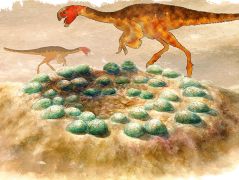
Massetognathus pascuali was an early ancestor of mammals; it was hairless, about the size of a dachshund, and lived around 230 million years ago. © Márcio L. Castro & AI-generated by Nano Banana (Google), edited and modified by Reiner Müller (FRM II)
230 million years ago, when the first dinosaurs roamed the Earth, an ancestor of mammals was already living. Massetognathus pascuali is classified within the group known as the Cynodontia, literally ‘dog-toothed’. It had hairless skin like a lizard, was about the size of a dachshund, herbivorous, and up to 70 cm long. The origin of mammals and the evolutionary changes that took place in their ancestors are the subject of heated debate among paleontologists.
First steps towards mammal brain
Paleontologists were particularly interested in the development of the brain because “a large and complex brain is a defining characteristic of mammals”, as Dr Leonardo Kerber, currently Humboldt Professor of Paleontology in Tübingen, emphasises. “We believe that the first steps towards this complexity began in the late Triassic, precisely the period when Massetognathus lived.” For example, the neocortex – a part of the cerebral cortex responsible for sensory and motor functions – first evolved in the cynodonts.

Dr Aureliano Tartaglione, as the instrument manager, carried out the neutron measurements on the skull using the ANTARES radiography facility at the MLZ. © Leandro Gaetano
Anatomy using neutrons
Although Massetognathus pascuali is one of the best-studied species, most of our knowledge of its brain anatomy is based on studies from the 1970s. “We are now presenting updated data on the anatomy of this remarkable species. By analysing Massetognathus pascuali using the ANTARES neutron tomography facility at the Heinz Maier-Leibnitz Centre at the Technical University of Munich, we have been able to study the anatomy of this species much more thoroughly than before,” says Dr Leonardo Kerber, one of the authors of the study from the Universidade Federal de Santa Maria in Brazil.
“Fossils of this species are abundant, but the new information we have obtained using neutron tomography is unprecedented,” enthuses Agustin Martinelli of the Bernardino Rivadavia Natural Sciences Museum in Buenos Aires, Argentina. Using neutrons, the researchers were able to produce higher-resolution and, moreover, 3D images of various brain regions within the skull.
Bad navigation without whiskers
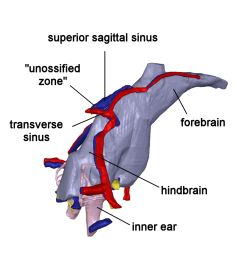
The researchers reconstructed the brain and nasal cavities, as well as the cavities containing the maxillary nerve. They discovered that most of the maxillary nerve, which supplies sensory nerves to parts of the face and teeth, had developed within the bone. “This suggests a lack of or poorly developed vibrissae (whiskers) in the nose, unlike in mammals,” explains Kerber. The animals need their whiskers to navigate in the dark and to find food. The nasal cavity, on the other hand, is well developed in this species, but lacks the nasal concha bones, which have a thermoregulatory function.
Lineage with whiskers survived
Key mammalian features, such as whiskers and increased neurological complexity, evolved within probainognathian cynodonts, the lineage that ultimately gave rise to mammals. In contrast, cynognathian cynodonts, including Massetognathus, became completely extinct by the end of the Triassic. “These physiological advances may have been crucial to the survival of the mammal lineage during the mass extinction at the end of the Triassic,” says Leonardo Kerber. “Palaeontology can be likened to a giant jigsaw puzzle, with every new discovery adding another piece. In this study, we are contributing a new piece that refines our understanding of the neurological development of mammalian ancestors,” says Leonardo Kerber.
Original publication:
T.G.M. Medina, A.G. Martinelli, L.C. Gaetano, L. Roese-Miron, A. Tartaglione, A. Backs, F.E. Novas, L. Kerber, Revisiting the neuroanatomy of Massetognathus pascuali (Eucynodontia: Cynognathia) from the early Late Triassic of South America using Neutron Tomography, The Science of Nature (2025), 112, 7. Link: https://link.springer.com/article/10.1007/s00114-024-01955-z; DOI: 10.1007/s00114-024-01955-z
Related News
MLZ is a cooperation between:
> Technische Universität München> Helmholtz-Zentrum Hereon
> Forschungszentrum Jülich
MLZ is a member of:
> LENS> ERF-AISBL
MLZ on social media: