MLZ is a cooperation between:
 > Technische Universität München
 > Helmholtz-Zentrum Hereon
 > Forschungszentrum Jülich
MLZ is a member of:
 > LENS
 > ERF-AISBL
MLZ on social media:




MLZ (eng)
Lichtenbergstr.1
85748 Garching
01.04.2026
€7.6 million for research with neutrons and positrons
From defect analysis in semiconductors with positrons to cancer therapy with neutrons: ten research projects at the Heinz Maier-Leibnitz Zentrum (MLZ) are receiving funding of around 7.6 million euros from the Federal Ministry of Research, Technology and Space (BMFTR).
Five projects have been secured by researchers from the Technical University of Munich, whilst a further five originate from other universities, whose research teams are contributing their expertise at the MLZ.

Funding began in early January 2026, or in 2025 for some projects, as part of the so-called ErUM-Pro Programmes, with each grant running for three years. ErUM stands for “Research into the Universe and Matter” and supports fundamental research in the natural sciences. “We are delighted that we can further develop our scientific instruments and thus continue to make good use of the time without neutrons from FRM II. Once we restart operations, we will be able to offer our visiting researchers new measurement options within a portfolio that is unique internationally,” says Prof. Christian Pfleiderer, Scientific Director of the Heinz Maier-Leibnitz Research Neutron Source (FRM II) and at the MLZ.

NEPOMUC's 5-fold switch in the Experimental Hall. © Bernhard Ludewig, FRM II / TUM
Six projects at the positron source
Prof. Dr Christoph Hugenschmidt from TUM is delighted that no fewer than six projects, totalling just under €4.7 million, will benefit NEPOMUC, the world’s most intense positron source at FRM II.
One project is replacing the Anger cameras, which are over 20 years old, with new detectors at NEPOMUC. This allows the scattered photons to be measured not only more efficiently, but also with three times higher spatial resolution. Analysing the angles measured this way makes it possible to precisely determine the momentum distribution of the electrons. “The positron beam is thus used to measure the electronic structure of the surface, thin layers and the bulk of a sample,” explains Christoph Hugenschmidt.
Christoph Hugenschmidt is also in charge of the SuSpect (Surface Spectrometer) project. “To measure both the structure and the elemental concentration on a single sample surface, it is necessary to combine two independent measurement methods in an ultra-high vacuum,” he says. The SuSpect project aims to overcome exactly this challenge from a technical perspective.

The positron instruments in 2021 - still in the Experimental Hall. They are currently being moved to the Neutron Guide Hall East. © Bernhard Ludewig, FRM II / TUM
Identifying defects as accurately as possible
Three further positron projects are being led by the University of the Bundeswehr (UniBw) Munich. For instance, Dr Werner Egger is planning to develop and construct a pulsed positron beam system (L-PLEPS), which is intended to be made available not only to researchers but also to industry for the investigation of defects in thin films of semiconductors, insulators, polymers and membranes. “Over the next decade, L-PLEPS will be the world’s most advanced platform, enabling the identification and characterisation of radiation damage in materials for fusion reactors with unprecedented speed and quality,” says Werner Egger.
With micrometre-level precision, the scanning positron microscope can detect defect distributions in samples. Project leader Prof. Dr Günther Dollinger from UniBW Munich explains: “Our aim is to significantly improve the resolution and performance of the scanning positron microscope at NEPOMUC through a series of upgrades.” Approximately €600,000 of funding is enabling this development.
Positrons from NEPOMUC also play a central role in the collaborative project “PosiLac”, led by Dr Michael Mayerhofer of the UniBW Munich (sub-project 1) and Dr Robert Heine of Johannes Gutenberg University Mainz (sub-project 2). The funding, totalling around 1.5 million euros, will be invested in the 3D printing of a high-frequency resonator. With the help of this resonator, the energy of the positrons can be significantly increased, which in turn enables the precise investigation of material defects in even deeper layers. “The project expands the range of applications for positron lifetime spectroscopy to a broader field of research: investigating deep-seated material defects is often a prerequisite for the development of high-performance materials. This will now also be possible,” says Michael Mayerhofer.

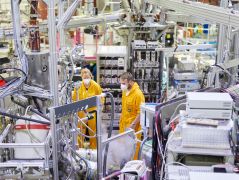
Johanna Jochum und Lukas Beddrich doing instrument scientist's stuff. © Astrid Eckert, FRM II/ TUM
Two upgrades at RESEDA
Dr Johanna Jochum from FRM II is responsible for two of the new projects at the RESEDA neutron resonance spin echo spectrometer, with a total of 1.8 million euros being invested in its further development. “The TIGER project aims to equip RESEDA for operation with thermal neutrons,” explains Johanna Jochum, who heads the RESEDA instrument team. The plan is to use the upgrade to higher energies to generate a stronger neutron flux for future cycles, opening up new fields of research.
The second project led by Johanna Jochum focuses on integrating focusing neutron optics into RESEDA. Although the existing technology in the instrument already offers very high resolution, it is less suitable for the examination of particularly small samples or measurements under pressure. “By integrating ‘nested mirror optics’, we aim to expand our capabilities to include this functionality,” says Johanna Jochum.

Working at ANTARES. © Bernhard Ludewig, FRM II / TUM
Test platform for electrolysis cells
Electrolysis cells enable the breakdown of molecules such as carbon dioxide to produce base materials for the chemical industry. In this process, the movement of water has a significant impact on the efficiency and lifespan of the cells. “To monitor the water level accurately, we need to examine the electrolysis cell as it is operating – thanks to a grant of nearly €670,000, we can develop just such a test setup for the instrument ANTARES and use neutron imaging to visualise the motion of water within the electrolysis cells,” explains Dr Michael Schulz, Deputy Scientific Director at FRM II. The project is led by Dr Joey Disch, a postdoctoral researcher at the University of Freiburg.

The irradiation room of MEDAPP. © Wenzel Schuermann
Neutrons in cancer therapy
Medical research also benefits from this funding. When boron is introduced into a tumour cell and then irradiated with neutrons, it transforms into two high-energy particles – in this process, the tumour cell is damaged. In addition to these two particles, characteristic gamma radiation is also released. “If we can measure the amount of this radiation in real time, we can draw much more accurate conclusions about how much radiation has been released in the tumour. With the funding of around 500,000 euros, we can now investigate and further develop this method here at the MEDAPP instrument – and thus contribute to making this form of therapy more targeted and precise,” says Dr Tobias Chemnitz, project leader and instrument scientist at MEDAPP.
MLZ is a cooperation between:
> Technische Universität München> Helmholtz-Zentrum Hereon
> Forschungszentrum Jülich
MLZ is a member of:
> LENS> ERF-AISBL
MLZ on social media: