MLZ is a cooperation between:
 > Technische Universität München
 > Helmholtz-Zentrum Hereon
 > Forschungszentrum Jülich
MLZ is a member of:
 > LENS
 > ERF-AISBL
MLZ on social media:




MLZ (eng)
Lichtenbergstr.1
85748 Garching
23.06.2026
Buddha’s backbone
Decades after Robert Oppenheimer first suggested using neutrons to analyse archaeological artefacts, an international conference in Munich organised by the MLZ demonstrates how this non-destructive technique illuminates our understanding of global cultural heritage.

Inside the Ratnasambhava statue: The neutron radiograph (right) shows the materi-als within, including the "life tree" that serves as its spiritual backbone. © Paul Scherrer Institut
From 19 to 22 May 2026, the Heinz Maier-Leibnitz Zentrum (MLZ), in cooperation with the Bavarian State Archaeological Collection, hosted the second edition of the International Con-ference on Neutrons in Heritage Science (NHS). It followed an initial conference in Dongguan, China, in November 2024. Held within thenewly refurbished state collection in Munich, the event drew 80 experts, curators, and neutron researchers from across the globe. “Hosted by the MLZ under the historic roof of the state collection, the conference highlights the value of bringing natural scientists and museum experts together to exchange ideas and develop new approaches to study cultural heritage”, says, Prof. Dr Christian Pfleiderer, Scientific Director of the MLZ and FRM II.
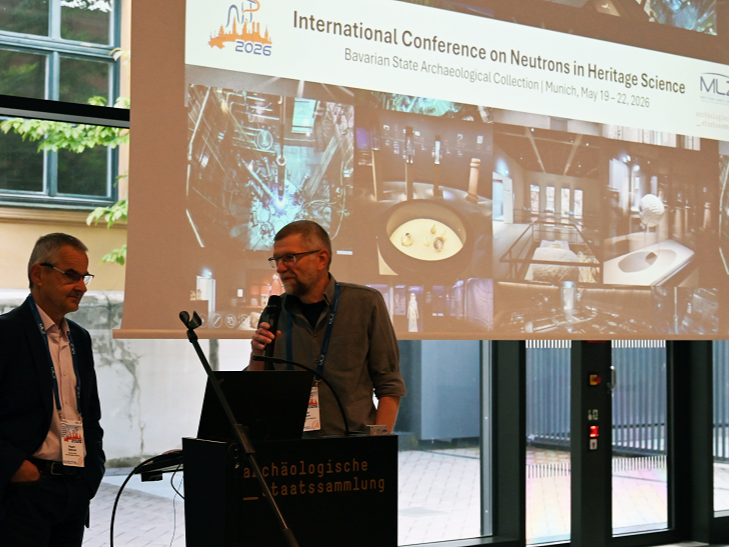
The conference organisers, Prof. Dr Rupert Gebhard, Director of the Bavarian State Archaeological Collection (left), and Dr Michael Hofmann (MLZ), welcome the audience. © Laura Richter, FRM II/TUM
Elemental fingerprint
Because neutrons penetrate easily through thick layers of heavy metals, while interacting strongly with light elements like hydrogen and carbon, they provide an unparalleled tool for looking inside fragile artefacts without causing damage. In his keynote talk, Prof. Dr Gilberto Artioli (University of Padua) gave a comprehensive overview of the different neutron tech-niques in analysing cultural heritage objects. While neutron radiography and tomography reveal hidden structures, Neutron Activation Analysis identifies the exact elemental composition through gamma-ray emissions, acting as an elemental “fingerprint”. Neutron diffraction complements this by uncovering crystal structures and phase compositions.
“Archaeology has always been exceptionally quick to integrate the latest analytical tech-niques. Through our 40 years of fruitful collaboration with the FRM II and its predecessor, the FRM, neutron science has become an indispensable tool,” says Prof. Dr Rupert Gebhard, Di-rector of the Bavarian State Archaeological Collection.

Apart from keynote speeches and scientific talks, the conference programme also comprised a preparatory workshop, a poster session, tours through the Munich Residence as well as the Archaeological State Collection and a trip to the Research Neutron Source FRM II in Garching. © Laura Richter, FRM II/TUM
Swords, statues, and sacred mysteries
The conference sessions showcased remarkable discoveries spanning millennia. For example, Dr Francesco Grazzi (DNR-IFAC) demonstrated how neutron tomography revealed the internal zigzag structures of 9th-to-11th-century Danish Viking swords. These blades, impressively longer than all others in Europe at the time, utilised complex pattern-welded cores for a tac-tical advantage in battle.
Highlighting the neutrons’ non-invasive power, Dr Eberhard Lehmann (Paul Scherrer Institute) summarised two decades of research on over 120 sacred Asian bronzes. Neutrons successful-ly peered inside metallic Buddha statues, revealing hidden textiles, gems, and “life trees” – central wooden pieces resembling a human backbone. Because physically opening these statues destroys their profound religious significance, this approach is invaluable. Rupert Gebhard added: “Thanks to neutrons, nobody has to cut open a sacred Buddha figure to in-spect its interior.”

Conference participants in front of the FRM II before taking a look at the reactor pool and touring the experimental hall housing neutron instruments. © Victor Beccari, SNSB Bayerische Staatssammlung für Paläontologie und Geologie
Bridging the disciplinary divide
The conference also catalysed essential debates regarding ethics, data communication, and interdisciplinary collaboration in the field. Humanities scholars and museum curators often lack the tools to analyse complex neutron scattering data independently, highlighting the urgent need for structural networks, standardised applications, and platforms for data shar-ing, as discussed in the session hosted by Dr Katharina Schmidt-Ott (Swiss National Museum) and Dr David Mannes (Paul Scherrer Institute).
“Our primary objective was to establish a bridge between researchers from large-scale neu-tron and X-ray facilities and the heritage community,” says Dr Yong Lei from the Palace Mu-seum in Bejing, Initiator of the NHS conference series and Programme Committee Chair. “The extraordinary collaborative spirit seen over these four days proves that solving historical puzzles requires a unified team effort. We are not just observing structures; we are develop-ing a profound understanding of how ancient societies manufactured, traded, and preserved their world.”
The community will meet again for the next NHS conference in Mito, Japan in 2028.
Artifacts from the State Archaeological Collection – Analyzed using neutrons in Garching


Related News
-
 01.09.2025
Probing the past with neutrons
-
 01.12.2023
Illuminating treasures of the past
MLZ is a cooperation between:
> Technische Universität München> Helmholtz-Zentrum Hereon
> Forschungszentrum Jülich
MLZ is a member of:
> LENS> ERF-AISBL
MLZ on social media: