MLZ is a cooperation between:
 > Technische Universität München
 > Helmholtz-Zentrum Hereon
 > Forschungszentrum Jülich
MLZ is a member of:
 > LENS
 > ERF-AISBL
MLZ on social media:




MLZ (eng)
Lichtenbergstr.1
85748 Garching
A reactor on the moon
14.06.2026
Nuclear energy is set to make crewed space stations on the moon a reality soon – what sounds like a distant future is currently being researched at FRM II. Aerospace engineer Julius Mercz is developing a reactor concept for the moon as part of his doctoral thesis, a project that is also funded by the European Space Agency (ESA). We spoke with him about the background of the project.

Julius Mercz, a doctoral student at FRM II is developing the design for a reactor on the Moon © Bernhard Ludewig; FRM II / TUM;
FRM II: What exactly are you planning for the space station on the moon?
Julius Mercz: We are developing a concept for a small nuclear reactor for lunar missions that could also be used for other missions in space. It is designed to provide continuous power for ten years and to use the waste heat to heat a planned base on the moon as well as to process local raw materials.
How is your reactor different from the large nuclear reactors on earth?
Our reactor is significantly smaller – about the size of a large refrigerator. It also has to be particularly lightweight, since it needs to be loaded onto a rocket and transported safely to the moon.
Why do we need nuclear energy on the moon at all? Why aren’t other forms of energy, such as solar energy, sufficient?
If we want to stay on the moon for a longer period, we quickly reach the limits of what solar energy can provide. There, after two weeks of daylight, there are two weeks of night, resulting in 14 days of complete darkness. This period would have to be bridged using batteries and significantly more solar panels. Both of these require more mass to be transported to the moon. In addition, solar cells lose efficiency over time due to micrometeorites and lunar dust. Nuclear power, on the other hand, can generate high energy and power density from a very small volume. Furthermore, the reactor can not only supply electricity but also use the generated heat to heat living spaces, for example.
There are many people who are initially put off by the term “nuclear reactor.” What safety concerns do you encounter most often when you talk about your research?
Most of the time, it’s about the rocket launch: What happens if the rocket explodes? Of course, this is taken into account in the design of such a reactor, and it’s the reason why, for example, we use a particularly resilient fuel made of small pellets. This fuel is very compact and extremely heat-resistant, so that even in the worst-case scenario of an explosion, no
radioactivity can escape. Furthermore, the reactor is designed so that it does not lose the fuel in the event of an accident.
Many people also have concerns about radiation. But on the moon, you’re exposed to strong cosmic and solar radiation anyway. The radiation from the reactor is negligible incomparison. Additionally, the reactor is to be embedded one to two meters deep in lunar rock, which further shields the radiation.
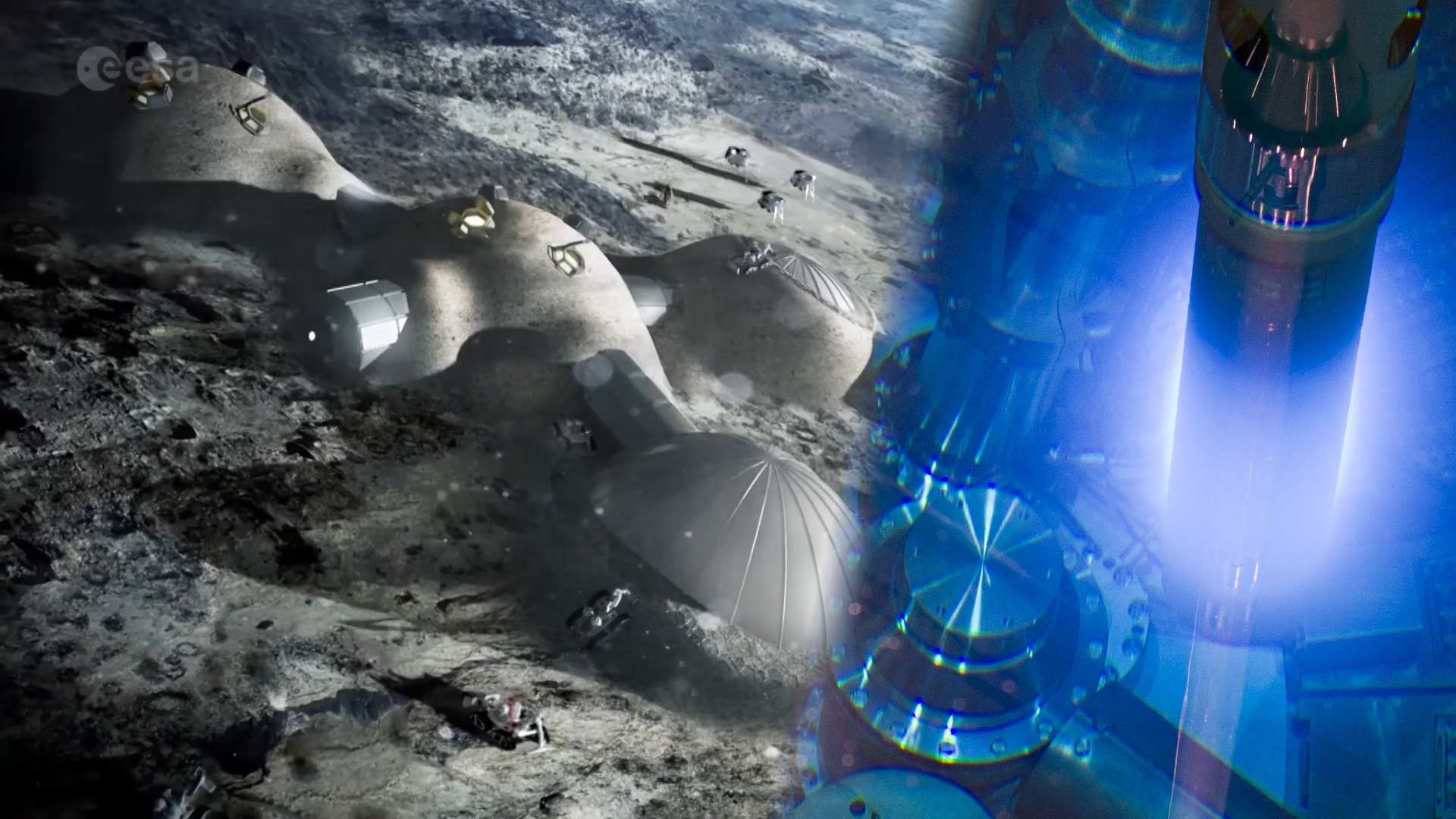
Simulation of the space station of ESA (l.). © ESA
Is there already a rough timeline for deploying such reactors?
The U.S. and NASA are working on similar projects and are planning to implement some of them as early as 2030. Our concepts are somewhat more complex, primarily due to the use of local resources. I consider it plausible that our plans can be implemented by the end of the 2030s.
What local resources do you use on the moon?
We use raw materials directly on the moon. Using the reactor’s waste heat, we can heat lunar rock to high temperatures and break it down into oxygen and metals through electrolysis. The oxygen is essential for the astronauts’ survival and for rocket fuel, while the metals can be used to build everything needed on site: spare parts, new structures, and the like.
How much longer will you be working on this project?
We’ll be working on it with ESA for another two years, together with Professor Dr Philipp Reiß from the TUM Chair of Lunar and Planetary Exploration. My goal is to have my dissertation completed by the end of the project as well. But we’re already thinking about whether we want to submit a new project proposal after the project ends to experimentally test the initial designs.
More information:
Link to the project website
Link to the Chair of Lunar and Planetary Exploration website
Related News
-
 29.07.2020
How stony-iron meteorites form
-
 11.12.2017
"Cloppenburg" analyzed with neutrons
MLZ is a cooperation between:
> Technische Universität München> Helmholtz-Zentrum Hereon
> Forschungszentrum Jülich
MLZ is a member of:
> LENS> ERF-AISBL
MLZ on social media: